Every Appointment, Every Time
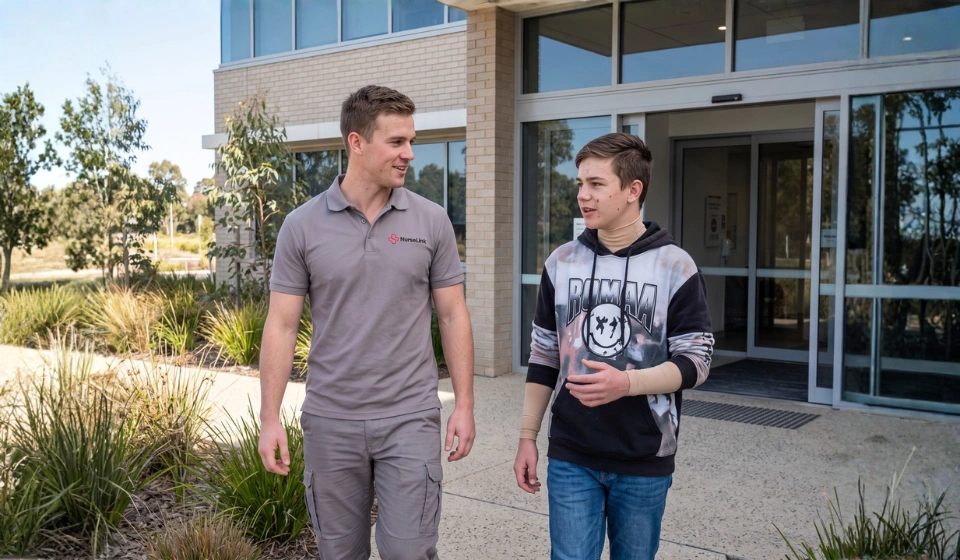
How NurseLink Supported A Teenage Burns Survivor To Attend His Reconstructive Treatment
A Case Study In Sensitive NEPT For A Young Person Navigating A Long And Demanding Recovery
Introduction
Recovery from serious burns is not a single event. It is a process that unfolds across months and years, through surgeries and dressing changes and compression garment fittings and the particular kind of physiotherapy that works against scar tissue that would prefer not to be worked against. It is a process that requires consistent, repeated engagement with a specialist clinical team, and that consistent engagement requires, for a young person without reliable independent transport, a transport solution that understands not just the physical requirements of the journey but the human ones.
A teenage boy who has survived a serious burn injury is carrying something that goes well beyond the physical. He is managing pain that is real and sometimes sudden. He is managing the particular self-consciousness of a young person whose appearance has changed in ways that the world around him notices and that he notices the world noticing. He is managing the disruption to the ordinary life of a teenager, the school, the friends, the sense of a future that was assumed to continue along familiar lines, that a serious injury produces and that no clinical team has a specific treatment for.
Getting this young person to his specialist appointments consistently, safely and in a way that honours the complexity of what he is carrying, is not a transport task. It is a clinical and human responsibility. And when it is done well, by people who understand both dimensions of what the journey requires, it becomes part of the support structure that makes the recovery possible.
At NurseLink Healthcare, we understand that non-emergency patient transport for a burns survivor is a distinct and specific undertaking. This case study documents how our team supported a teenage boy in Melbourne, Victoria, through a sustained period of reconstructive treatment following a serious burn injury sustained in a car accident, and how the consistent, dignified transport we provided became one of the stable elements of a recovery that asked a great deal of him and his father.
To protect the privacy of the client and his family, all names and identifying details have been kept confidential throughout this case study.
The Young Person & His Situation
The young person at the centre of this case study is a boy aged between sixteen and eighteen who lives with his father in Melbourne’s western suburbs. He sustained serious burns to his upper body, neck and part of his face in a car accident that occurred when he was a passenger in a vehicle driven by a friend. The accident itself was the kind of sudden, catastrophic event that does not leave room for preparation, and the weeks that followed it, in the burns unit of a major Melbourne hospital, were among the most difficult of his and his father’s lives.
He had been, before the accident, a fairly ordinary teenager in the ways that matter. He went to school. He played sport on weekends. He had a group of friends he had known since primary school and a relationship with his father that was, by his father’s account, close in the practical, unspoken way of fathers and teenage sons who understand each other without talking about it much. He had plans, loosely held in the way of teenagers whose future is so obviously ahead of them that planning it feels premature.
The accident changed the shape of what ahead looked like. The burns he sustained required multiple surgical procedures, extended skin grafting and a reconstructive treatment programme that his specialist team at a Melbourne burns clinic had mapped out across the following twelve to eighteen months. The programme included regular clinic appointments for wound assessment, compression therapy and scar management, surgical procedures scheduled at intervals determined by his healing progress, physiotherapy to manage the contracture risk that serious burns carry, and the psychological support that his treatment team had wisely built into the programme from the outset.
His father, who worked in a trade and had managed the weeks of his son’s hospitalisation by taking leave he could not entirely afford and sitting in the burns unit for hours each day, was now managing a return to work alongside the transport demands of a treatment programme that required his son to attend the burns clinic several times a month at a location that was not easily accessible from their home by public transport. His son’s own licence was still some months away, and the physical discomfort that his burns and compression garments produced made the idea of public transport for a journey of this length both clinically inadvisable and practically very difficult.
The burns clinic’s social worker, who had been supporting the family through the post-hospitalisation transition, identified the transport gap and contacted NurseLink Healthcare.
Understanding What He & His Father Actually Needed
The initial conversation NurseLink Healthcare had with the family involved both the young person and his father, which was the right approach for a sixteen year old who was old enough to have clear views about his own situation and young enough to need his father in the room while he expressed them.
He was not forthcoming initially, which was not surprising. He was a teenager who had been through something serious and who had, in the weeks since leaving hospital, been managing the particular self-consciousness of a person whose appearance had changed in ways that were visible to the world. He had not yet returned to school. He had seen his close friends but had found some of those interactions more difficult than he had expected. He was, in the way of teenage boys managing something they do not have the language for, largely quiet about most of it.
What he communicated, when the care coordinator asked him directly what he needed from a transport arrangement, was specific in the way that people who are managing something difficult often become specific about the practical details because the practical details are easier to talk about than everything else. He needed the vehicle to be comfortable, because his compression garments and the skin grafting sites made certain positions painful for extended periods and the journey to the burns clinic was long enough that comfort mattered. He needed the transport officer to not make a thing of his appearance, which he said without elaboration and which the care coordinator understood completely. And he needed, though he did not say this in words, to feel like a person being taken somewhere rather than a patient being transported, because the distinction between those two experiences was one he had become sensitive to across the weeks of hospitalisation.
His father’s needs were equally specific. He needed a transport arrangement he could rely on completely, because the alternative to reliable transport was him leaving work for each appointment, which was not financially sustainable across a treatment programme of this length. He needed the transport officer to be someone he trusted with his son, which he expressed in the direct way of a man who has recently come very close to losing the person he is talking about and has not yet fully processed what that means. And he needed the communication around each appointment to be clear and timely, because managing the anxiety of a parent whose teenage son is attending medical appointments without him required information, not reassurance.
The NurseLink Healthcare Solution
A Transport Officer Selected For This Specific Assignment
NurseLink Healthcare identified a transport officer for this engagement whose background and personal manner were specifically suited to what was required. He had experience transporting patients from specialist medical settings, an understanding of the physical comfort requirements of burns patients including positioning considerations and compression garment sensitivities, and a manner that was straightforward and respectful in the specific way that a teenage boy who did not want his appearance to be a thing would respond to.
Before the first appointment, the transport officer was briefed comprehensively on the young person’s clinical profile, his comfort requirements for the journey and the specific interpersonal approach that the care coordinator had identified as appropriate. He was told, clearly, that the young person was not looking for sympathy or for careful handling in the emotional sense. He was looking for someone who would treat him normally, which in the context of his current situation was the most considerate thing anyone could do.
The transport officer made contact with the family the day before the first appointment, a brief and straightforward call to confirm the pickup time and to introduce himself as a person before the day. The young person did not say much on the call. His father thanked the transport officer and said they would be ready.
The Journey Managed Around His Physical Needs
The vehicle NurseLink Healthcare confirmed for the engagement was selected with specific attention to the comfort requirements of a burns patient wearing compression garments across a journey of significant length. The seating configuration, the temperature management and the route planning were all considered in advance, with the specific goal of making the journey as physically undemanding as possible for a young person whose body was doing significant work simply managing the healing process without the additional load of an uncomfortable vehicle environment.
Departure times were planned to allow a relaxed boarding process, with no rushing, and to deliver him to the burns clinic with enough time to settle before his appointment rather than arriving at the last minute after a journey that had been physically effortful. The return journey, which typically followed appointments that had involved dressing changes or physiotherapy and that left him more fatigued and sometimes more uncomfortable than he had been on the way there, was managed accordingly, with a quieter vehicle environment and a pace that was unhurried and attentive to how he was travelling.
His transport officer checked in with him at the start of each return journey with a brief, practical question about whether he was comfortable, which he answered briefly, and then managed the journey in the way the answer indicated, without making the check-in a clinical moment or a concerned one. It was simply the ordinary attentiveness of a person who was paying attention, offered in a way that did not require the young person to perform gratitude or manage anyone else’s feelings about his situation.
Treating Him Like A Person, Not A Patient
The quality that the young person had asked for and that his father had echoed in different words, the experience of being treated like a person rather than a patient, was the quality that NurseLink Healthcare had specifically selected this transport officer to provide and that the transport officer provided consistently across the engagement.
He did not make a thing of the young person’s appearance. He did not adjust his manner in a way that signalled that he was being careful, because careful can be its own form of drawing attention to the thing you are being careful about. He engaged with him in the direct, low-key way of two people sharing a car for a purpose, asking occasionally about the football when there was something worth asking about, responding to the music the young person sometimes put on with the ordinary tolerance of a person in someone else’s car, and being otherwise present and attentive without being a presence that required management.
Over the weeks of the engagement, something gradual happened that his father noticed without immediately commenting on. His son started talking a little more on the way home from appointments. Not about the appointments, usually, but about ordinary things. A game he had watched. Something that had happened in his group chat. The small ordinary things of a teenager’s life that had, for a period, been crowded out by everything else. His father heard about these conversations when his son got home, passed on in the way that teenagers pass things on, briefly and without apparent significance. He took each one as the evidence it was.
Consistent Scheduling Across The Treatment Programme
NurseLink Healthcare coordinated the transport schedule with the burns clinic’s appointment system, confirming bookings in advance and maintaining a standing arrangement across the full treatment programme rather than managing each appointment as a separate booking. This meant that the family’s transport for the foreseeable future was arranged, confirmed and reliable, without his father needing to make individual arrangements for each appointment on top of the other management demands of their situation.
When appointments were rescheduled by the clinic, NurseLink Healthcare adapted the transport schedule accordingly and communicated the changes to his father promptly. When a surgical procedure required a different transport arrangement than a standard clinic appointment, NurseLink Healthcare confirmed the appropriate vehicle and escort configuration in advance. The arrangement flexed around the treatment programme rather than requiring the treatment programme to flex around it.
His father noticed this too. He had expected to have to manage the transport coordination himself, as he had been managing most things since the accident. The experience of it simply being handled was one he mentioned at a check-in call several months into the engagement, not with effusiveness but with the particular gratitude of a person who had been carrying a lot and had been relieved of one thing.
Communication That Kept His Father Informed
After every appointment, his father received a brief message confirming that his son had attended, that the journey had gone without issue and noting anything relevant about how he had seemed on the return trip. The messages were short and specific, because that was what his father needed, a clear and reliable signal that his son was safe and on his way home, rather than a detailed report that required reading and processing.
On the one occasion during the engagement when the young person had been more quiet than usual on the return trip following a particularly difficult dressing change, the transport officer had noted it in the message to his father without alarm and without clinical assessment, simply as an observation that his son had been tired after today’s appointment and that the journey home had been quiet. His father read this, called his son when he got home, and the conversation that followed was one he described to the care coordinator as one of the more real conversations they had had since the accident. He was grateful for the heads up that had made it possible.
Outcomes & Impact
He Attended Every Scheduled Appointment
For the full duration of NurseLink Healthcare’s transport involvement, he attended every scheduled burns clinic appointment without exception. The treatment programme that his specialist team had mapped out proceeded on schedule, without the gaps that missed appointments would have produced in a clinical programme where the timing of interventions was meaningful. His reconstructive treatment advanced as his specialist team had planned, and the transport arrangement was never the reason it did not.
His Physical Recovery Proceeded Without Transport-Related Disruption
The specific clinical outcome of consistent attendance at a burns reconstruction programme across a sustained period is not a simple single data point. It is the accumulation of wound assessments completed on schedule, physiotherapy interventions delivered at the intervals that scar management requires, compression therapy maintained and adjusted appropriately and surgical procedures performed at the clinically optimal timing that the preceding assessments had determined. NurseLink Healthcare’s transport made all of this possible by ensuring that the clinical programme was never disrupted by the logistics of getting him there.
Something In Him Began To Expand Again
The most significant outcome of the engagement was not one that appeared in any clinical record. It was the gradual, quiet expansion of the young person’s engagement with his own life across the months of the transport arrangement. He returned to school. He started seeing his friends more regularly. He began, according to his father, talking about what he was going to do after school in a way that suggested the future was beginning to feel like something that belonged to him again rather than something that had been interrupted.
His father attributed this to many things, the clinical progress, the psychological support, the time that had passed. He also attributed it, in part, to the ordinary, consistent, undramatic experience of getting into a vehicle every few weeks and being taken somewhere and treated like a person who was going somewhere, rather than a patient who was being managed. The normalcy of that experience, small in isolation and significant in accumulation, had been part of what the recovery had needed.
His Father Had One Less Thing To Carry
The practical relief of a transport arrangement that required nothing of him beyond knowing it was in place was, in his father’s assessment, more significant than he had anticipated. He had been managing an enormous amount since the accident, and the removal of the transport coordination from his list of things to manage had effects that reached beyond the practical. He had slightly more capacity for the other things the situation required. He was slightly less depleted at the end of each week. These were not dramatic improvements, but they were real ones, and in a situation where everything was being managed at the edges of what was sustainable, real improvements mattered.
A Reflection From His Father
Several months into the engagement, his father shared the following with the NurseLink Healthcare care coordinator:
“After the accident, I was just trying to get through each week. Every appointment, every form, every thing that needed organising felt like something else on a list that was already too long. The transport was one of the things I was most worried about because I couldn’t be there every time and I needed to know he was in good hands. NurseLink took that off the list. Every appointment, he got there. He got home. The bloke who drove him treated him like a normal kid, which sounds like a small thing and isn’t. My son started talking again on those drives home. That matters more than I know how to say.”
Key Takeaways From This Case Study
Consistent transport is part of a burns reconstruction programme, not separate from it. A treatment programme that depends on regular clinical attendance will be undermined by inconsistent transport. NurseLink Healthcare’s involvement ensured that the clinical programme his specialist team had designed was never disrupted by the logistics of getting him there.
Burns patients have specific physical comfort requirements that transport must accommodate. Compression garments, skin grafting sites and the positioning sensitivities that serious burns produce require specific consideration in the vehicle environment. Transport that does not account for these is not adequate transport for a burns patient, regardless of its other qualities.
A teenage burns survivor needs to be treated as a person, not a patient. The self-consciousness of a young person whose appearance has changed as a result of injury is real and significant. A transport officer whose manner signals that the young person’s appearance is something to be managed around, however subtly, adds to what the young person is already carrying. An officer who treats him with the ordinary respect of one person to another provides something genuinely therapeutic in its ordinariness.
Reliable transport relieves the primary carer as well as the patient. A father who does not have to manage the transport coordination for his son’s treatment programme has slightly more capacity for everything else the situation requires. That additional capacity, however small it appears in isolation, has real effects on a carer who is managing at the edges of what is sustainable.
Conclusion
Recovery from serious burns is long and demanding and does not follow a straightforward line. It requires consistent clinical engagement, significant personal resilience and the support of the people and systems around the person doing the recovering.
For the young man at the centre of this case study, NurseLink Healthcare provided transport that was one of those supports. Consistent, comfortable, appropriately managed and delivered by a transport officer who treated him like a person going somewhere rather than a patient being moved. He attended every appointment. His treatment proceeded as planned. And somewhere in the ordinary consistency of getting into a vehicle and being taken somewhere and being treated normally, something in him began to expand again.
That is what transport, done well, can do. Not just deliver a person to a clinic, but be part of the environment in which a person finds their way back to themselves.
If your family is managing a long-term medical treatment programme and reliable transport is part of what makes it possible, we encourage you to reach out to the NurseLink Healthcare team. We are here to make sure that getting there is never what stands between a patient and their recovery.
Latest Post
Getting Him Home, Then Getting Him Better
Getting Him There, Getting Him Home, Getting Him Through

When Getting To Care Is Part Of The Challenge
Getting There Made The Difference
Showing Up For Someone Nobody Else Was Showing Up For
Getting There Safely
Every Appointment, Every Time
One More Day With Her Family
The Journey Home
The First Step Out The Door
Every Tuesday & Thursday

Bridging The Gap To Treatment
More Than A Ride Home
Every Trip Counted
The Right Equipment. The Right Team. The Right Outcome.
Maintaining Treatment Continuity During Cancer Care
Safe Non-Emergency Patient Transport
Ensuring Safe & Consistent Medical Access
A Safe Journey Home After Surgery