
Every Trip Counted
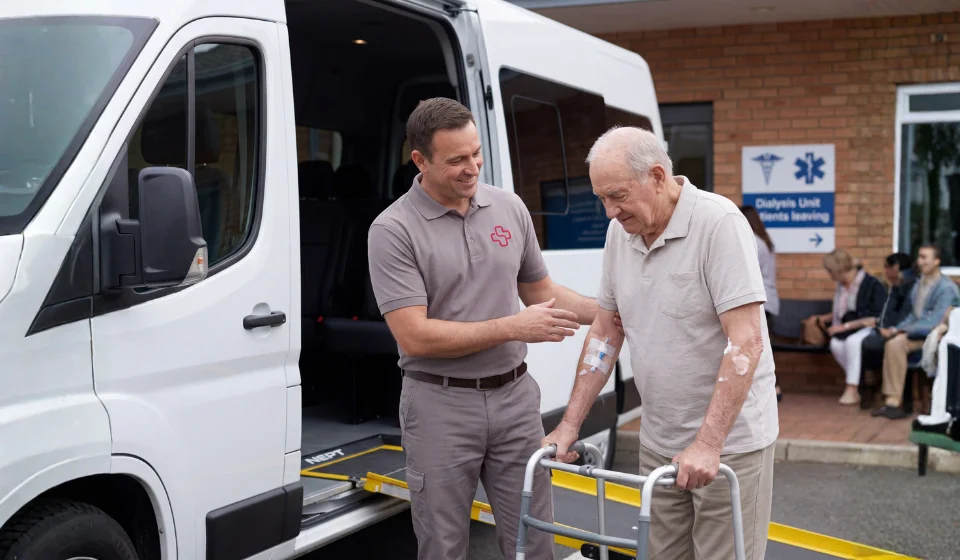
How NurseLink Healthcare Delivered Non-Emergency Patient Transport For An Elderly Dialysis Patient
A Real-World Example Of NEPT Built Around Clinical Safety, Not Just Getting From A To B
Introduction
For a person living with end-stage kidney disease, dialysis is not a medical appointment. It is a lifeline. Three times a week, without fail, the journey to and from a dialysis centre must happen – regardless of how the patient is feeling that day, regardless of what else is going on in their life and regardless of the clinical complexity they bring with them to every single trip.
Non-emergency patient transport for a dialysis patient sounds, on the surface, like a straightforward logistical task. Get the patient there. Wait. Bring them back. What that description misses entirely is the clinical reality of what dialysis does to a body, particularly an elderly body carrying multiple comorbidities alongside the kidney disease itself. Patients frequently finish sessions fatigued, haemodynamically altered and in no condition to manage an unassisted transfer. The vehicle taking them home is not simply transport. It is the last clinical touchpoint of a medically intensive day.
When the patient in question has a complex medical profile that requires a clinically trained presence on board for every journey, the stakes of getting transport right are not logistical. They are clinical.
At NurseLink Healthcare, our Non-Emergency Patient Transport service is built around exactly this reality. This case study documents how our team delivered safe, consistent and clinically appropriate transport for an elderly man in Shepparton, Victoria attending dialysis three times weekly, giving him and his family the confidence that every journey was being managed with the same seriousness as the treatment itself. To protect the privacy of the patient and his family, his name and all identifying details have been kept confidential throughout this case study.
To protect the privacy of the client and his family, his name and all identifying details have been kept confidential throughout this case study.
The Patient's Background & His Challenges
The patient is a man in his late sixties who has lived in Shepparton for most of his adult life. A regional city in northern Victoria, Shepparton sits approximately two hours north of Melbourne and has a strong network of local health services – including a renal dialysis unit at Goulburn Valley Health – that serves both the town itself and the surrounding rural communities. He had been receiving haemodialysis three times per week for approximately two years following the progression of chronic kidney disease to end-stage renal failure.
His kidney disease did not arrive in isolation. He carried a complex medical profile that included insulin-dependent type two diabetes, ischemic heart disease, peripheral vascular disease affecting both lower limbs and a documented history of hypotensive episodes following dialysis sessions – a pattern his renal team at Goulburn Valley Health had been monitoring and managing carefully but had not been fully able to eliminate.
He was not a man who spoke easily about needing help. He had spent decades working in the agricultural sector, had owned and run his own property for many of those years and carried the self-reliance that tends to come with that kind of life. But the cumulative toll of his conditions, combined with what dialysis demanded of his body three times a week, meant that his capacity on treatment days was genuinely and unpredictably limited.
His wife did not drive. Their adult children had moved away from Shepparton years earlier. In the early months of his dialysis, a collection of informal arrangements had been assembled – lifts from neighbours, occasional visits from family and a community transport booking service that operated on a fixed schedule too rigid to accommodate the variability of how he presented after each session. That arrangement had broken down on two occasions when he had experienced a significant hypotensive episode following treatment and the transport waiting for him was neither equipped nor staffed to respond to it safely.
His renal care coordinator at Goulburn Valley Health had raised the transport situation formally as a clinical concern. The recommendation from that review was unambiguous: given his history of post-dialysis hypotension and his cardiovascular profile, every journey required a provider with clinical capability on board. NurseLink Healthcare was identified through the unit’s network of recommended NEPT providers and engaged following a direct referral.
Understanding What The Patient & His Family Actually Needed
NurseLink Healthcare’s initial assessment was thorough and clinically grounded. His full medical history was reviewed, his treating team at Goulburn Valley was consulted and the specific pattern of his post-dialysis presentations – the timing and triggers of hypotensive episodes, the symptoms that typically preceded them and the interventions that had been effective – was documented in detail and incorporated into the transport brief for every journey.
His wife’s situation was taken seriously as part of the assessment. She had been present for both of the incidents with the previous transport service and was carrying an anxiety about his dialysis days that had built steadily since. What she needed was not simply reassurance. She needed to know that the people taking her husband were genuinely equipped for whatever the session produced – that if something changed in that vehicle, it would be recognised and managed by someone who understood what they were seeing.
The patient himself was direct about his expectations. He wanted punctuality, because the dialysis unit ran on a fixed schedule and late arrivals created problems for staff and other patients. He wanted consistency – the same people, the same routine, the kind of familiarity that meant he did not have to explain himself from scratch on every trip. And he wanted to be treated as the capable man he was on the days he was managing well, not handled as though every journey were a crisis waiting to happen.
These inputs shaped an arrangement that was clinically rigorous without being unnecessarily clinical in its manner.
The NurseLink Healthcare Solution Delivered
Clinically Staffed Transfers For Every Journey
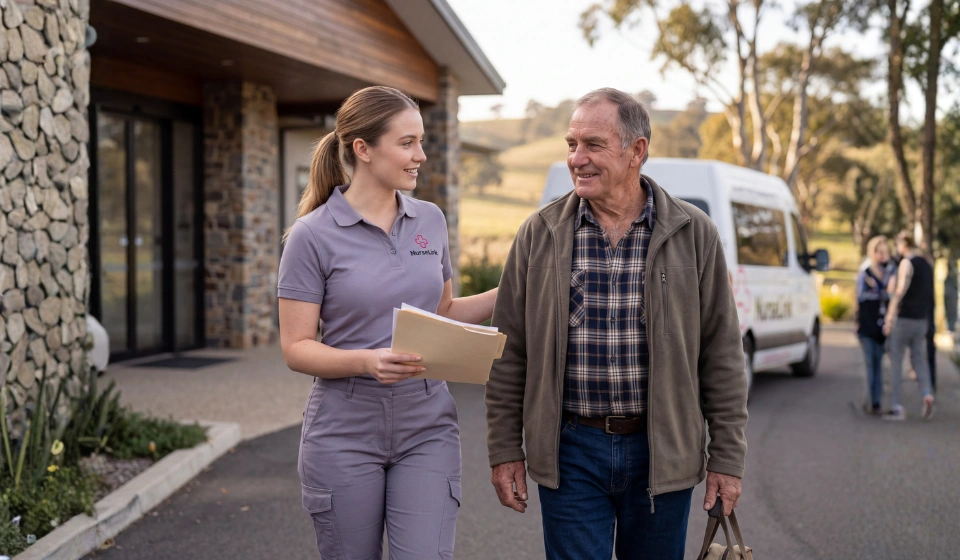
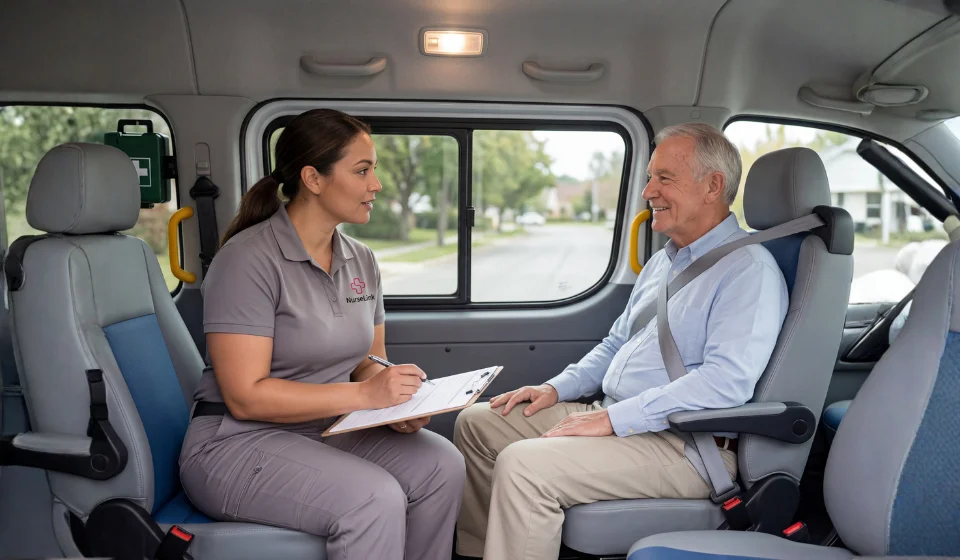
Every transfer provided to this patient included a qualified clinical staff member on board alongside the driver – not as a contingency for exceptional circumstances but as the standard for every single journey. Given his documented history of post-dialysis hypotension and his cardiovascular comorbidities, NurseLink Healthcare determined from the outset that a clinically capable presence was a non-negotiable baseline, not an optional extra.
The clinical staff member assigned to his transfers was briefed thoroughly on his medical history, his medication regime, the specific presentation of his hypotensive episodes and the escalation protocol if required. Vital signs were monitored and recorded at the commencement and conclusion of each journey, with any readings outside expected parameters communicated to his renal care coordinator at Goulburn Valley Health the same day.
Consistent Crew & Familiar Routine
NurseLink Healthcare assigned a consistent primary crew to his regular transfer schedule wherever operationally possible. Within the first month, the same two people were collecting him for the majority of his sessions. They knew his routine, his preferences and how he typically presented on a good day versus a difficult one. He knew their names. His wife recognised their vehicle pulling into the driveway.
For a patient whose medical presentation varied from session to session, being transported by people with a genuine baseline understanding of him made the identification of concerning changes more reliable. Familiarity was not a comfort feature. It was a clinical asset.
Post-Dialysis Monitoring During Transfer
The period immediately following a session represented the highest clinical risk in his transport journey. NurseLink Healthcare’s protocol incorporated a structured observation period before departure from the unit – allowing the clinical staff member to assess his presentation before the vehicle moved – followed by active monitoring throughout the return journey to his home in Shepparton.
On three separate occasions across the engagement, the clinical staff member identified early signs of a hypotensive episode during the return journey and managed it appropriately before it progressed. On each occasion, his renal team was notified, his wife was called and the episode was documented in his care record. None of the three required emergency escalation. Each was managed safely because the right person was in the vehicle.
Punctuality & Schedule Reliability
The dialysis unit at Goulburn Valley operated on a strict patient scheduling system, and late arrivals had downstream consequences for other patients and staff. NurseLink Healthcare built his transfer schedule with appropriate travel time buffers and a clear communication protocol for the rare occasions when delays were unavoidable, ensuring the unit always had advance notice rather than a last-minute surprise.
Across the engagement period, his on-time arrival rate at the unit was above ninety-five percent – a figure his care coordinator noted was among the most consistent of any transport-dependent patient on the schedule.
A Connected Communication Loop With His Care Team
A structured communication loop was maintained between NurseLink Healthcare and his renal care coordinator throughout the engagement. Post-transfer notes were submitted following each journey, flagging any observations of clinical significance. When his treating team adjusted his post-dialysis protocol following a medication review, NurseLink Healthcare’s crew brief was updated the same day. The transport function and the clinical function operated as parts of the same connected care system rather than two arrangements that occasionally shared information.
Outcomes & Impact
Every Dialysis Session Was Attended
Across the full engagement period, the patient did not miss a single dialysis session due to a transport failure. For a patient whose life depends on the regularity of that treatment, this is not a minor operational achievement. It is a clinical one.
Three At-Risk Episodes Were Identified & Managed Safely
The three post-dialysis hypotensive episodes identified and managed during transfers represented precisely the scenario his renal team had been concerned about when transport had been raised as a clinical issue. In each case, the clinical presence on board meant the episode was caught early, managed appropriately and documented for the treating team. The alternative – those same episodes occurring in a vehicle without clinical staffing – carried a risk that neither his care team nor his family were willing to contemplate.
His Wife’s Anxiety Reduced Significantly
His wife described the period before the NurseLink Healthcare arrangement as one in which she spent every dialysis day waiting in a state of quiet dread – not knowing what condition he would be in when he came home or whether the people with him would be able to manage it if something went wrong. Within the first month of the arrangement, she described that dread as largely gone. She knew who had him, she knew they were clinically qualified and she knew she would be called by someone who understood what was happening if anything changed.
His Care Team’s Confidence In The Transport Arrangement Was Established
His renal care coordinator, who had originally raised the clinical concern about his transport, described the NurseLink Healthcare arrangement as the first time she had felt genuinely confident that the transport component of his care was being managed to the standard his medical profile required. The consistency and quality of the post-transfer documentation contributed directly to her ability to monitor his condition between clinic appointments.
Patient Reflection
The patient’s wife shared her experience of the NurseLink Healthcare arrangement several months in:
“After what happened those two times with the other service, I was frightened every time he left the house for dialysis. He’d sometimes come home looking terrible and there was nobody with him who really understood what to do. With NurseLink it is completely different. The same people collect him, they know him, and I know that if something happens in that car it will be handled properly. He hasn’t missed a single session. That might sound like a small thing but for us it is everything.”
Key Takeaways From This Case Study
Non-emergency does not mean low-risk. For patients with complex medical profiles, the post-treatment transfer window carries genuine clinical risk. A transport provider without clinical capability on board is not equipped to manage that risk, regardless of how routine the journey appears on paper.
Post-dialysis transfers require clinical oversight as a standard, not an exception. Hypotensive episodes following haemodialysis are well-documented and common. For patients with a known history of this presentation and significant cardiovascular comorbidities, clinical staffing of every return journey is not an elevated service tier. It is the appropriate baseline.
Consistency of crew is a clinical asset in complex patient transport. Transport staff who know a patient’s baseline presentation are better positioned to identify deviation from it. For medically complex patients making regular journeys, building familiarity through consistent crew assignment improves the quality of clinical observation on every trip.
Transport and clinical care must communicate as one system. When the transport provider operates in isolation from the treating team, observations made during transfers are lost and adjustments to the clinical plan are not reflected in the transport protocol. A provider who treats communication with the care team as a core responsibility produces materially safer outcomes.
For dependent patients and their families, reliability is itself a clinical outcome. A patient who misses dialysis sessions due to transport failure suffers a direct clinical consequence. A family member carrying chronic anxiety about whether their loved one will be managed safely carries a burden that affects their own health and wellbeing. Consistent, dependable transport that families can genuinely trust addresses both.
Conclusion
For a patient whose treatment depends on getting to the same place and back, safely, three times a week without exception, transport is not a peripheral concern. It is woven into the fabric of their clinical care. And when that patient carries a medical profile that makes every return journey a potential clinical event, the standard to which that transport is delivered must reflect the seriousness of what is at stake.
At NurseLink Healthcare, our Non-Emergency Patient Transport service is built around the understanding that the vehicle is the last clinical environment a patient passes through on a treatment day. We staff it accordingly, we communicate accordingly and we take responsibility for what happens in it accordingly.
This case study is an example of patient transport at its most purposeful — a man in Shepparton whose treatment could not wait, a family who needed more than a driver and a service built around the clinical reality of both. If you or someone in your care requires non-emergency patient transport and the situation demands more than basic logistics, reach out to the NurseLink Healthcare team today. We would welcome the opportunity to help.
Latest Post
Getting Him Home, Then Getting Him Better
Getting Him There, Getting Him Home, Getting Him Through

When Getting To Care Is Part Of The Challenge

Getting There Made The Difference
Showing Up For Someone Nobody Else Was Showing Up For
Getting There Safely
Every Appointment, Every Time
One More Day With Her Family
The Journey Home

The First Step Out The Door
Every Tuesday & Thursday

Bridging The Gap To Treatment
More Than A Ride Home
Every Trip Counted
The Right Equipment. The Right Team. The Right Outcome.
Maintaining Treatment Continuity During Cancer Care
Safe Non-Emergency Patient Transport

Ensuring Safe & Consistent Medical Access

A Safe Journey Home After Surgery