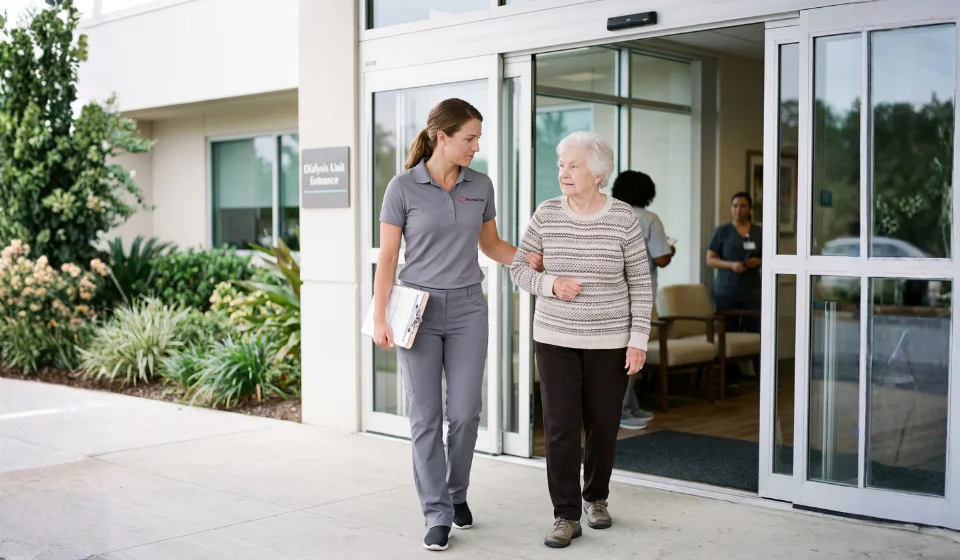
The First Step Out The Door

How NurseLink Healthcare Helped A Man With PTSD And Panic Disorder
A Case Study In Sensitive, Trauma-Informed Patient Transport For A Patient Whose Greatest Barrier Was The Journey Itself
Introduction
For most people, getting to a medical appointment is a logistical challenge. A time to arrange, a route to plan, a car park to find. For a person living with severe PTSD and panic disorder, the journey to an appointment can be the appointment’s greatest obstacle. Not the clinical encounter itself, not the conversation with the psychiatrist, not the vulnerability of sitting across from someone and describing what has happened and what it has done. The journey. The leaving of the house. The exposure to an unpredictable environment. The loss of the controlled, familiar space that has become, over months or years of avoidance, the only place that feels safe enough to inhabit.
Agoraphobia is a word that most people understand loosely, as a fear of open spaces, but the clinical reality is considerably more specific and considerably more disabling than the loose definition suggests. It is the anticipatory terror of situations from which escape might be difficult or help might not be available if something goes wrong. It is the panic attack in the supermarket that makes the supermarket impossible the following week. It is the gradual narrowing of the world to the dimensions of a house, a room, a corner of a room, as avoidance reduces the anxiety in the short term and reinforces it in the long term.
For the man at the centre of this case study, that narrowing had been happening for years. He had not attended a psychiatric appointment in a long time, not because he did not want the help but because the process of getting to it had become, in itself, more than he could manage. The transport that NurseLink Healthcare provided was not simply a vehicle. It was the clinical and human bridge between the corner of his house where his world had contracted to and the appointment room where something might begin to expand it again.
At NurseLink Healthcare, we understand that non-emergency patient transport for people with severe mental health conditions requires a specific kind of skill, a specific kind of patience and a specific kind of human presence that goes well beyond driving. This case study documents how our team supported a man in his mid-forties in Adelaide, South Australia, to attend his first psychiatric appointment in years, and what it took to make that journey possible.
To protect the privacy of the client and his family, all names and identifying details have been kept confidential throughout this case study.
The Client & His Situation
The client is a man in his mid-forties who lives in a house in Adelaide’s southern suburbs with his partner, who has been his primary support person through a period of significant mental health decline that had its origins in a traumatic event several years earlier. He had worked before the onset of his current condition in a trade, was practical and self-contained by nature and had, by his own account and his partner’s, never been a person who found it easy to ask for help or to admit that something was beyond him.
The PTSD had developed in the aftermath of a workplace incident that he does not discuss in detail and that is his own to keep. What followed the incident was a period of significant psychological deterioration that had not been adequately recognised or treated in its early stages and had progressed, across the following years, to a clinical picture that included severe panic disorder, significant agoraphobia and a pattern of avoidance that had progressively reduced the world he was able to inhabit to the space of his home and, on the most difficult days, to a smaller space within it.
His partner had been managing the weight of living alongside this with a combination of love and exhaustion that she kept largely to herself because she understood, with the particular clarity of someone who has lived closely with someone else’s PTSD for years, that her own needs were not the ones that could be addressed first. She had been encouraging him toward psychiatric support for a long time and had learned, through experience, that encouragement produced defensiveness and that the timing of the suggestion mattered more than its content.
The timing had arrived, finally, through a crisis that had frightened him enough to accept what she had been suggesting. His GP had made a psychiatric referral. An appointment had been booked. And then the reality of what attending that appointment required had settled over the household like a familiar weight, because the appointment was across the city and getting there meant leaving the house and getting into a vehicle and travelling through an environment that his nervous system had spent years learning to interpret as threatening.
His GP, who had known him for several years and who understood the specific nature of the barrier, had contacted NurseLink Healthcare with a specific request. Not just transport. Transport that understood what it was transporting.
Understanding What He Actually Needed
The initial conversation NurseLink Healthcare had with his GP and subsequently with his partner was one that covered clinical ground that most transport assessments do not reach. His partner described his condition with the accuracy of someone who had been living alongside it for years, and she was specific about what the transport arrangement needed to provide and what it absolutely could not do.
He needed a transport officer who would not be visibly anxious, because his nervous system was exquisitely sensitive to the anxiety of people around him and would interpret it as confirmation that the situation was dangerous. He needed someone whose manner was calm in the specific way that is not performed calmness, which he would identify immediately and which would make things worse, but genuine, settled, matter-of-fact calmness that communicated through its ordinariness that the situation was ordinary.
He needed the vehicle environment to be controlled. No unpredictable sounds, no sudden stops if they could be avoided, a route that had been planned in advance and that his partner had been able to describe to him before the day so that there were no surprises. He needed to know that if he needed the vehicle to stop, it would stop. That if he needed more time before getting in, he would have it. That the pace of every part of the journey was negotiable and that nothing would be hurried because the appointment time was fixed and the traffic was unpredictable.
He needed, and this his partner said with the particular emphasis of someone who had seen what happened when it was not present, to be treated as a man who was managing something difficult, not as a patient who was being managed. The distinction, she said, was the difference between a journey he could attempt and one he could not.
His partner also asked whether she could ride in the vehicle with him. Not to manage him, she said, but because his nervous system was more regulated in her presence than in anyone else’s and because the first time was going to be the hardest time and she wanted to be there for it. NurseLink Healthcare confirmed that she could.
The NurseLink Healthcare Solution
A Transport Officer Selected For This Specific Assignment
The selection of the transport officer for this engagement was treated by NurseLink Healthcare with the same seriousness that a clinical placement decision receives, because the clinical implications of getting it wrong were direct and significant. A transport officer who was professionally competent but personally ill-suited to the specific demands of transporting a patient with severe PTSD and panic disorder could, through manner alone, make the journey more difficult than not going at all.
NurseLink Healthcare identified a transport officer with experience transporting patients with mental health conditions and a personal manner that the care coordinator assessed, through a specific conversation about this engagement, as genuinely suited to what was required. He was unhurried by nature. He was comfortable with silence. He did not fill space with conversation when conversation was not needed. And he had the specific quality of steadiness that does not come from training but from temperament, the kind of person whose presence in a room or a vehicle makes the room or vehicle feel marginally safer than it did before they arrived.
He was briefed comprehensively on the client’s condition, his specific triggers, the communication approach that his partner had described and the practical arrangements that had been agreed for the journey. He was told about the route. He was told about the stopping arrangement. He was told what a panic attack during the journey might look like and how to respond to it. He was told, most importantly, that the appointment time was not the priority. Getting there in a condition to attend was the priority, and if the former was sacrificed to achieve the latter, that was the right outcome.
He made contact with the client’s partner the day before the journey, not to run through logistics but to introduce himself as a person before the day, so that the man who would be getting into his vehicle the following morning had already heard his voice and knew, in the small but meaningful way that prior contact provides, something about who was coming.
The Morning Of The Appointment
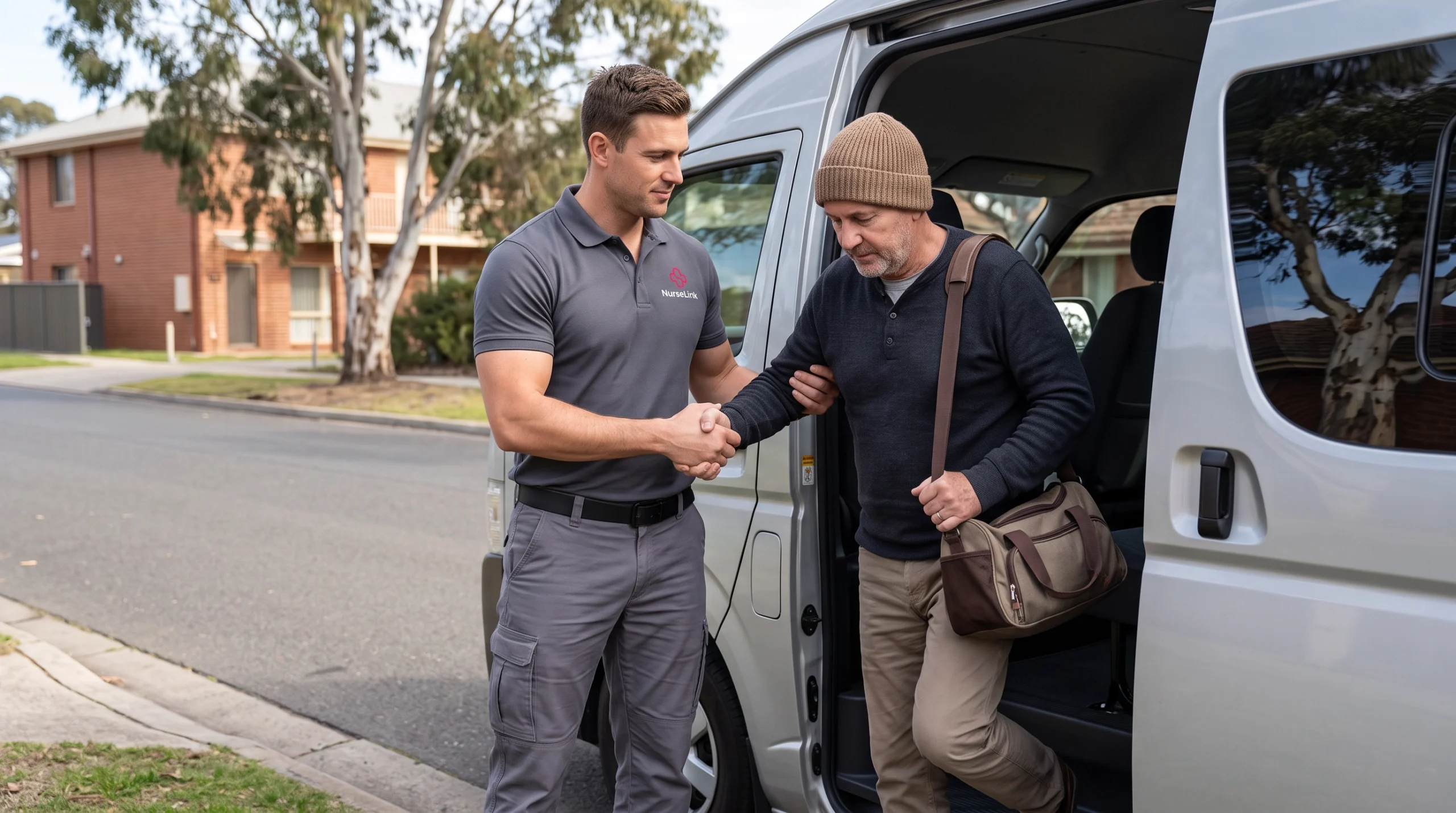
The transport officer arrived at the house at the agreed time and did not knock immediately. He had been told that his partner would signal from the window when the client was ready and that arriving and waiting, quietly and without pressure, was the right approach for the first minutes of the arrangement. He waited. He did not look at his phone. He stood by the vehicle in the way of someone who had nowhere else to be and nothing more pressing to attend to, which was exactly the message that the moment required.
When the client came to the door, assisted by his partner, the transport officer introduced himself briefly and did not extend his hand because his partner had mentioned that unsolicited physical contact in an anxious state was not helpful. He said the vehicle was ready whenever they were. He said there was no hurry. He meant both things.
Getting into the vehicle took longer than a standard transport boarding. There were several minutes at the door where the client stood and breathed and his partner stood beside him and said nothing useful and everything necessary by simply being there. The transport officer waited by the vehicle and did not watch. When they were ready, he opened the door and they got in.
The Journey Itself
The route had been planned and communicated to his partner in advance, and there were no surprises. The transport officer drove at a pace that was calm and consistent, avoiding the sudden accelerations and braking that an anxious passenger interprets as hazard. The vehicle was quiet. No radio. A temperature that had been set to comfortable before they boarded. The route that had been described.
His partner sat beside him and held his hand for most of the journey. The transport officer drove and said nothing unless something needed to be said, which was rarely. There was one moment, approximately halfway through the journey, when the client’s breathing changed in a way that indicated the beginning of a panic response. The transport officer, without being asked and without drawing attention to what he was doing, pulled smoothly into a side street and stopped the vehicle and said, still without turning around, that they were stopped and there was no hurry and they would go when he was ready.
They sat for several minutes. His partner talked to him quietly. His breathing slowed. He said he was ready. They continued.
He arrived at the clinic. He went in. He attended his first psychiatric appointment in years.
The Return Journey & What It Meant
The return journey was quieter than the outward one, in the way that a person who has done something hard is quieter afterward. He sat with his eyes partly closed and his partner’s hand still in his and did not say much. The transport officer drove the same route back and said nothing at all except, at one point, that it was a good day for it, meaning the weather, which was mild and clear, and which was both entirely innocuous and, in the context of what the day had been, exactly the right thing to say.
He was returned to his front door. His partner thanked the transport officer with a specificity that went beyond courtesy, telling him that the stop in the side street had been the thing that had made it possible to continue. The transport officer said he was glad it had helped and that he hoped the appointment had been worthwhile.
He went inside. His world was, for the moment, exactly the same size it had been that morning. But something had happened in it that had not happened for years, and the possibility that it might happen again, that the size of his world might slowly, carefully, with the right support, begin to expand, was more present than it had been in a long time.
Outcomes & Impact
He Attended The Appointment
The outcome that had been in genuine doubt when the engagement was being planned had occurred. He had left his house, travelled across Adelaide in a vehicle with a stranger, managed a panic response mid-journey and arrived at and attended a psychiatric appointment that he had not been able to attend for years. That this had happened was, in the assessment of his GP, his partner and the psychiatric team who saw him, a clinically significant event in the trajectory of his mental health management.
The Psychiatric Team Had A Patient To Work With
His psychiatrist, who had received a referral and a clinical history but had not met him before the appointment, described the consultation in a communication to his GP as productive and as the beginning of a therapeutic relationship that she was cautiously optimistic about. The fact that he had arrived, had engaged with the consultation and had agreed to a follow-up appointment was the clinical outcome that made everything else possible. NurseLink Healthcare’s transport had made him available to receive the psychiatric care that his condition required.
His Partner Had Evidence That It Was Possible
For his partner, who had been hoping for this day for longer than she could clearly remember, the outcome of the journey was not just that he had attended the appointment. It was that she had seen him do something she had not been sure he would be able to do, and that what she had seen had given her a piece of evidence against the fear that things could not get better. Evidence matters when you have been managing on hope for a long time. She had some now.
The Foundation For Ongoing Transport Was Established
NurseLink Healthcare’s transport arrangement for the initial appointment had been designed with the understanding that a single successful journey was the first step in an ongoing transport relationship that would support his continued psychiatric engagement. The transport officer who had managed the first journey was confirmed for the follow-up appointments, because the relationship that had been established in that first journey, the knowledge of the stopping arrangement, the familiarity of the voice and the manner, was a clinical asset that would make each subsequent journey more manageable than the one before.
A Reflection From His Partner
In a follow-up conversation with the NurseLink Healthcare care coordinator, his partner shared the following:
“I have been trying to get him to that appointment for a long time. I knew the transport was going to be the hardest part and I was terrified it was going to be the part that stopped it from happening. The officer who drove us was exactly what he needed. He stopped when he needed to stop. He waited when he needed to wait. He treated my husband like a person who was managing something hard, not like a problem to be moved from one place to another. We got there. That sounds simple. It was everything.”
Key Takeaways From This Case Study
Mental health transport requires trauma-informed practice, not just clinical awareness. A transport officer working with a patient with PTSD and panic disorder needs more than an awareness that the passenger is anxious. They need the specific skills and the specific temperament to manage the journey in a way that reduces rather than amplifies the patient’s distress. NurseLink Healthcare’s selection and briefing of the transport officer for this engagement reflected this understanding.
The journey to the appointment is part of the clinical intervention. A patient who arrives at a psychiatric appointment having been transported in a way that has triggered their anxiety is not in the clinical condition that the appointment requires. The quality of the transport experience directly affects the quality of the clinical encounter it delivers the patient to. NurseLink Healthcare’s approach treated the journey as clinically significant in its own right.
Flexibility during transport is not a concession, it is a clinical requirement. The stop in the side street that allowed the client to manage his panic response mid-journey was not a deviation from the plan. It was the plan working as it was designed to. Transport for patients with severe anxiety must be structured around the patient’s needs rather than the schedule, and a transport officer who understands this is providing a categorically different service from one who does not.
The first successful journey changes what subsequent journeys are possible. A patient who has completed a difficult journey once has evidence that it is possible that they did not have before. That evidence is clinically valuable and compounds across subsequent journeys as the transport arrangement becomes familiar and the anticipatory anxiety that the unknown produces is gradually replaced by the relative comfort of the known.
Conclusion
The world of a person with severe PTSD and panic disorder can contract to a very small space over a very long time, and the distance between that space and the door of a psychiatric clinic can feel, from the inside, like a distance that cannot be crossed.
NurseLink Healthcare provided the transport that helped one man in Adelaide cross that distance. Not by making it easy, because it was not easy, and not by pretending it was straightforward, because it was not. But by providing a transport officer who understood what the journey required, who stopped when stopping was needed and waited when waiting was needed and drove when driving was possible, and who treated a man managing something very hard with the respect and the steadiness that gave him enough to keep going.
He attended his appointment. His psychiatrist has a patient. His world is the same size it was, for now. But the door has been opened, and that is where all of it begins.
If someone you love is struggling to access mental health care because the journey to it feels impossible, we encourage you to reach out to the NurseLink Healthcare team. We understand that sometimes the transport is the treatment, and we are here to provide it with the care it deserves.
Latest Post
Getting Him Home, Then Getting Him Better
Getting Him There, Getting Him Home, Getting Him Through

When Getting To Care Is Part Of The Challenge
Getting There Made The Difference
Showing Up For Someone Nobody Else Was Showing Up For
Getting There Safely
Every Appointment, Every Time
One More Day With Her Family
The Journey Home
The First Step Out The Door
Every Tuesday & Thursday

Bridging The Gap To Treatment
More Than A Ride Home
Every Trip Counted
The Right Equipment. The Right Team. The Right Outcome.
Maintaining Treatment Continuity During Cancer Care
Safe Non-Emergency Patient Transport
Ensuring Safe & Consistent Medical Access
A Safe Journey Home After Surgery